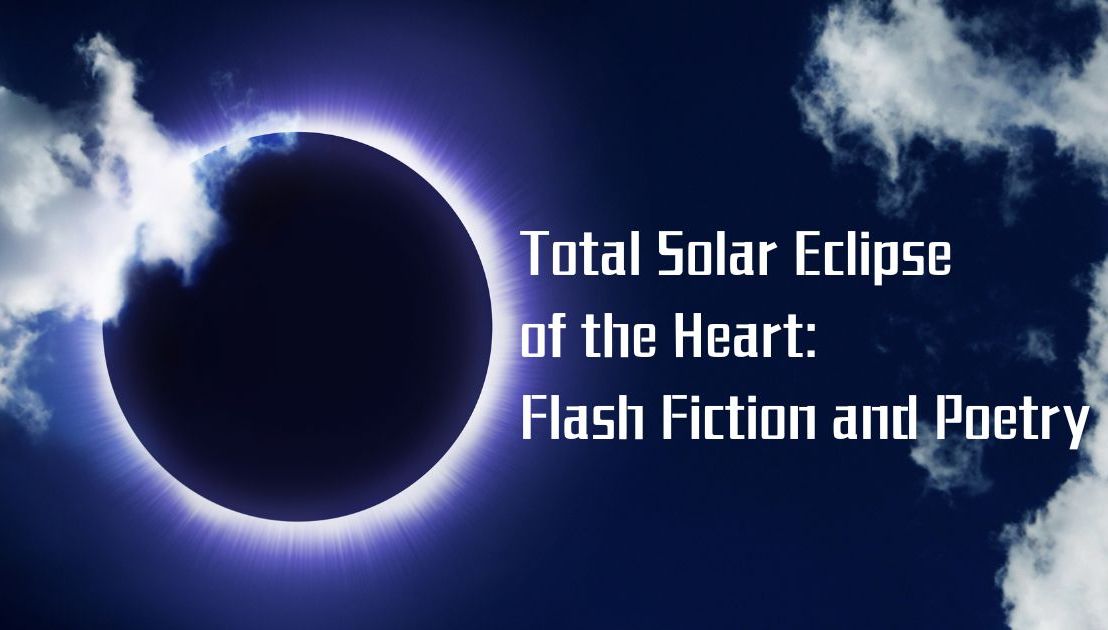
Those That Thunder Takes
Beneath its wing I trembled, the beat of my heart a cacophony in my ears. she held me so close, the warmth and grit of its scaly feet clutched around my arms. Her head hung, with an eye turned up towards the heaven in wait. Hours ago she found me, plucked me from my home.
“Where could he be?” my wife’s voice sang in my mind with visions of her stumbling through the grass and wildflowers in bloom. Far above that bird, I stole fleeting glimpses of the sun that dimmed. A vast cosmic mouth, hungrily gulping it down like a plump field rat in the jaws of a snake. As it greedily snatched the sun away, I could hear the faintest of rumbles growing in the gullet of that massive bird. Building eagerly as we watched the sun slip away.
And as night took day, that rumbling turned to a thunderous caw of expectant bliss, deafening all else. All at once, the beat of my heart faded, and so too did the sing-song voice of my wife as the chill set in. It was so cold, a chill that seeped from the deep ache in my chest as my thoughts slipped away, and that horrible cawing fell silent, my body jerked and twitched with each elated nip of that thunderbird’s jaws into me. As sleep took me, I glimpsed upon the sun with slitted eyes, its beauty breaking night once more as I fell into oblivion.
The Vampire & The Hunter
She’d forgotten what the sun felt like.
The moon was safe. Even when danger roamed under the cover of shadows where the moon’s light did not reach, she bared her fangs. The moon did not burn against the deathlike pallor of her skin. The moon did not illuminate her secrets, allowing her to drink blood in peace.
But when the shy man with golden hair and a smile that brightened up a room found her one night, he did not stake her heart. Instead, he offered a blood bag.
As she drank, they sat beneath the moon’s glow. He spoke like birds sang. Sun-kissed, his skin was warm to the touch in a way she hadn’t felt in centuries.
With time, she hoped he’d offer her his neck. She dreamed of how warm his blood must be, with all his time in the sun. Its rays seemed to emit from him every time he smiled or laughed. It reminded her of when she was human, when she could emerge during the daylight without risk of burning alive.
She’d gotten so used to his warmth that when he lured her away from the shadows and into the day, she almost didn’t realize how the blue sky—so much brighter than she remembered—swallowed her whole. As her vision flashed to white, she almost didn’t realize how the sun that gave him life devoured her own.
She’d forgotten what the sun felt like until he came along. And then, she felt nothing at all.
Made of Fire and Cheese
I used to look at the sky and wonder out loud,
what was beyond the dreamy, blue nothing and its cotton clouds.
The moon was of cheese, and the sun was of embers,
both engraved in a feeling I long to remember.
The stars twinkled their red and blasted their blue,
forever feeding the minds in forms of a muse.
The night and the day would talk in their codes,
but always made sure to light the same North.
It’s funny how now that North is hidden in haze,
and the stars are nothing but lingering planes.
The sun blazes and blinds, leaves fire in its wake,
but it seems like it’s almost begging for the pain.
The moonlight became for lovers and secrets,
likely the one thing that will never breach them.
The bare sky is now jarring, but clouds threaten rain,
and everyone knows we can’t welcome those stains.
Lately I wonder if both can be true.
Can the stars wink their greeting while I cry at the moon?
And so what if the sun begs things to flee,
surely sometimes we can smile up with glee.
The blue skies may never reveal what they truly hold,
but maybe that mystery is what makes chaos gold.
Non-Fiction
There have been eclipses since the beginning of Earth’s ellipsis. I remembered this as I walked out the front yard to see my first one. The southern california weather was normal: blue sky, shaded palm trees, a light breeze. I was here to see the “ish” in normalish–the black blip of the sun and moon together. I remember being told not to look directly at it: the internet would have a field day with our president doing the same. In this moment, I thought of Orpheus and Eurydice: Hadestown was a year away, so I remembered D’Audelaire’s telling. He couldn’t obey because of what catastrophes it took to get him here. He could not imagine more to come. But now he was in the stars: if he could try, could he see me, with some wonder and dread, seeing the unnatural portends I could in a box that used to hold my possessions and would again?
The Full Moon
The yard was bathed in moonlight.
He liked nights like these, when everything was still and the full moon perched high in
the sky. He would lift his face to the star-speckled sky, just taking in these rare moments of quiet. He had never believed in moon rituals or anything supernatural; his wife always warned him how the full moon brought out strange creatures, but he brushed her off. He had been doing this every month for a long while, and he had never run into werewolves or other beings she
adamantly believed in. He never felt anything but recharged after standing under the full moon; it was his safe place.
But tonight, he heard a growl.
His eyes snapped open. He looked at the tree line at the yard’s edge, staying still as
something shiny caught his eye, like two small moons. A coyote, maybe—they didn’t get
anything bigger than coyotes around these parts, and while he didn’t want to have a run-in with a coyote, he knew he wouldn’t be meeting anything worse.
Right?
Another glimmer caught his eye, and his breath caught in his throat. He took a step back, only for his foot to catch on a branch. He collided with the ground, but he barely noticed the pain jolting through his tailbone—not when the moonlight caught a gleaming mouthful of sharp teeth.
His fear turned into his wife’s voice in his head as the creature crept closer:
Watch out for the werewolves.
Solar Eclipse
A hush falls over the crowd, and newfound darkness cools my skin.
Tiny fingers squeeze my hand. “Mommy, the sun! It’s hiding.”
“Make sure you’re wearing your glasses, or else you’ll end up like me,” I tease.
“I am.” Her small voice pitches in awe. “I wish you could see it, too.”
I smile at her and see galaxies. Her happiness, a supernova, her heart, the sun. In her hands she holds my soul like a black hole, inescapable and infinite in its love. Her laugh is starlight sprinkled in the black, her innocence a comet streaking past.
Fleeting.
And I am suspended in time, a moment of zero gravity before the weight of reality pulls me into its atmosphere and stings the back of my eyes.
These memories are my eclipse, the halo of light breaking through the blackness. Rare. Beautiful. Brief. The smooth contours of the engraving they leave on my heart will be the only witness of their existence, saying, I was there. I held my universe in my palm while she gasped in admiration.
If only she realized the cosmic wonder she beheld was a shadow of the multitudes within her.
“Don’t worry,” amidst the darkness, I squeeze her hand in return, “I’m not missing a thing.”
Shadow Life
He slaps the eclipse glasses back on his face and runs outside again. Crescent shadows pepper the back porch as he gazes up, rapt, fingers already shaping the scythe in the sky. He rushes back to the kitchen table, filling another box in his progression study.
Were there eclipses when I was a child? Why don’t I remember them? The 3 R’s were more important, apparently. I slide another pair of glasses onto my own face. Maybe we spend our lives trying to give our children the things we never had, but that doesn’t mean we have to live vicariously. We could just live.
I study the sky and the shadows at my feet, as fascinated by science as he is in this moment. I shiver as the last wisps of sunlight fade, the birdsong abruptly silenced. A strange wind sweeps across my skin. “Come here, buddy!” I shout as the corona flares. “This is so cool!”
He grins at me, then looks skyward. “Yeah, it is!”
We stand together until our shadows reappear, growing across the porch and anchoring our feet back to the earth.
A Night Under the Stars (in Aunt Laura’s Truck)
“That’s the Big Dipper—see? Those stars make the handle, and those are the cup.”
Aunt Laura aimed a wrinkled but deceptively strong hand up to the dark, clear sky. “Okay…I think I see it,” I said. It was a fib. I thought the clear, dark sky just looked like a million pinpricks on a giant Lite Brite. I couldn’t make any order or pattern out of it.
But that was okay; I wanted to hear what Aunt Laura would say next.
I’d finished first grade a few weeks earlier, and my parents were stuck working late—an occupational hazard for nurse anesthetists. So I spent this Carolina summer night in the bed of my Aunt Laura’s white pick-up truck, looking at stars and listening to her stories under the sweetgum tree.
And did she have stories! From thrilling historical adventures to personal accounts of Great Depression hardships to spooky-but-not-too-frightening ghost stories, Aunt Laura kept me entertained with nothing more than a flashlight and her imagination. She told me her sons, who grew up and moved away years earlier, once found Revolutionary War relics in the sprawling soybean field beside her house. And then she held up the Mason jar containing musket balls, metal buttons, and tattered canvas.
I snacked on my bowl of dry Froot Loops and soaked up every tale. Then the headlights of my parents’ Chevy Malibu obscured the stars. I knew Mom and Dad were exhausted, but I wish I could’ve stayed for one more story.
Mother
Mother
My sun is a slowly closing eye
Her heart rages
I imagine her roar
calling out to the black emptiness
for eons past
and when at last she blinks out,
her molten heart turn to ice
I will recall fondly her warmth on my face,
as I spin round the void,
and regret the days I ever shielded her from my eyes.
Stare hard , my friends.
We will all be blind before long
A Cosmic Kiss
The sun, our star, the beacon of light to our world by day.
The moon, our satellite, the silver nightlight to our dreams at night.
Once in a blue moon, these two meet, just briefly, to dance in the celestial heavens and kiss under the midnight sky. Our little moon. Our giant sun. How impressive are the odds these two could align perfectly from our viewpoint to provide a spectacular cosmic show?
In the path of solar eclipse totality, under the bright blue sky, scarce white puffy clouds line the horizon. Schools are closed, friends gather, and expressways become congested. Tourists book hotels, gas prices increase, and grocery shelves become empty. We dig out our special solar eclipse safety glasses and sit outside in parks, backyards and even on rooftops to get a glimpse, just a moment in history, when the world goes dark, and these two celestial beings align.
As the air becomes chilled, dark shadows creep over the land.
Day meets night. Shadow meets light.
The sky turns black and bright diamond-like sparkles shine from the brilliant stars above.
In the moment of totality, the sun and moon overlap and kiss the midnight sky with a ring of fire. A meeting of celestial beings. A kiss in the heavens.
What If I Can’t Be a Hero?
I feel like an idiot sitting here by the water and waiting for the solar eclipse. What stupidity to even dream that when this eclipse comes and goes, that I would become different? Yet, what if I did change? Would I change for the better, and if I gained some kind of power, wouldn’t I then become a target, envious by some and feared by others? I should go inside. But I can’t. It’s growing darker, and the water nearby almost speaks to me. Something is happening. I feel something, a change, I think. Please, God, just let me be different. Give me some kind of ability that I won’t feel helpless every damn day as the world breaks apart around me. There goes the sun. There goes the water. Stillness. Darkness. Yet, I remain.
Fibonacci Poem: Solar Eclipse
“Don’t
look!”
they say.
Our urge is
to seek out the strange —
defy beauty’s awful logic.
There be Monsters
Facing brightened eyes,
under sunlit skies,
Humans stumbled through the days.
Among cheery smiles,
who passed them by,
with “Hello’s” and “Good day’s”.
There be monsters in the sun.
Pretenders that thrive in the light.
With pick pocket lies and alibis.
Every coin set in their sights.
And so, the beat went on.
Sun shining down, on weary brows,
Souls toiled through the days.
Some had nothing left to give,
and began to fade away.
But mother moon had been watching,
and disapproved of what she’d seen.
Fifty, fifty had been the deal,
but not what she received.
These creatures that returned to her,
at the end of every day, were used up
With no honor left to pay.
No will to wish upon a star,
or linger in their lovers’ arms.
No dreaming of tomorrow.
Without the honor of these gifts
The moon would more than wane
Without the worship in our play
She’d simply drift away
So, a Titan embraced humans,
who were fading far too soon.
And tucked them under cover.
In the silverest of rooms.
While plying them with honeyed cakes,
and healing herbal teas,
she read to them “Goodnight moon,”
before she turned away to leave.
The triple goddess of the moon,
pulled the night across the day.
Then strolled down to the Otherworld.
And gathered the demons’ names.
Then cast the lot away.
The mother, maiden, and the crone,
Drowning them in the river Styx,
‘Til it flows the other way.
There be monsters in the dark,
And monsters in the day.
Waiting in the crossroads,
is the goddess Hecate.






 Wild Ink Publishing
Leave a comment