
By Emily Groff
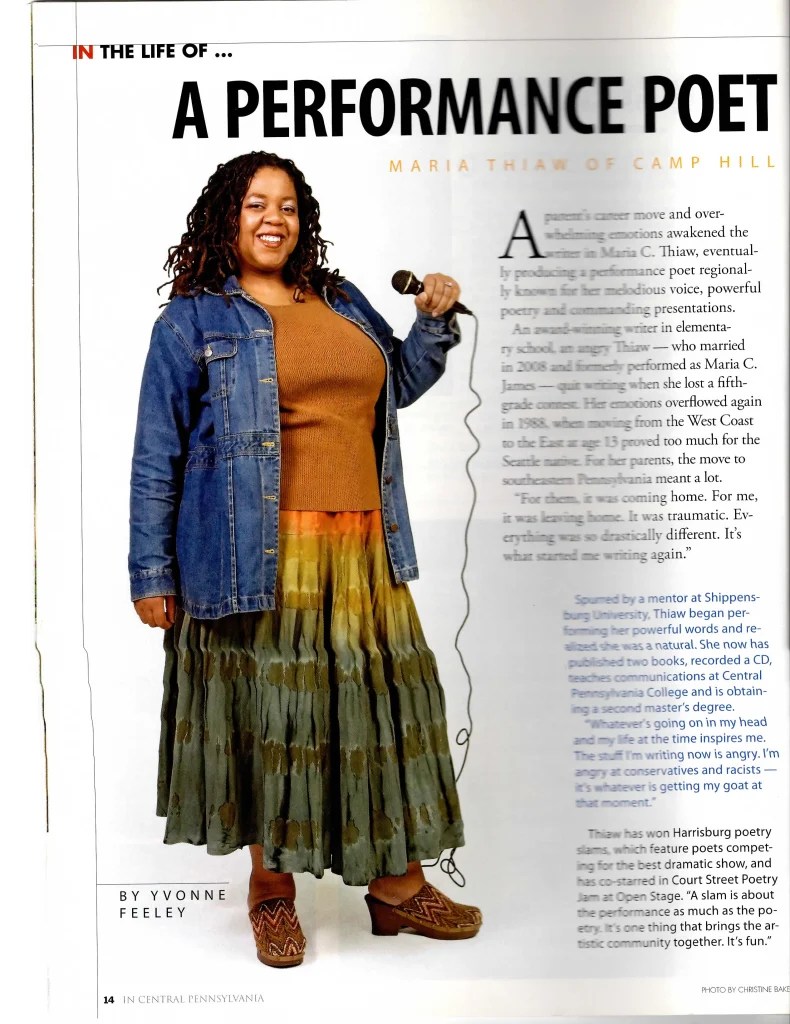
How do you decide to become a poet? For Maria James-Thiaw, it was easy. She has known she was a poet since the age of four–it only took her learning the alphabet to string words together to make beautiful lyrical pieces. By the age of seven, she had gone to share her poems on her father’s TV show, making herself and her work known. She has since become an award-winning poet, performer, and playwright.
Maria James-Thiaw performs and writes to seek justice. With her Reclaim Artist Collective, she is working hard to bring her American Griot Project programming to marginalized communities. She aims her goals high and never plans on abandoning them. Learn more about Maria James-Thiaw and her poetic journey in this interview.
When did you first know you wanted to start writing? What got you interested?
I decided to be a poet when I was 4. Of course, I didn’t know how to write, I barely knew the alphabet. I saw my father reading his poetry to others, and I decided that when I learned my letters, I would make up poems. I wrote my first collection of poems at the age of 7 and won the Seattle Pacific University Young Writers’ Conference.

Tell me about your poetry book: Count Each Breath.
A healthcare system built on bias and inequity, a system of policing that snatches our sons & daughters from our arms, and a pandemic painting a target on our backs–this is 2020 through the eyes of a black woman with chronic illness. If you’ve ever been dismissed, ignored, suspected, or accused by a healthcare provider, you will relate to these verses.
Why should readers read your book? What is your target reader for each book?
If you’ve ever been dismissed, ignored, suspected, or accused by a healthcare provider, you will relate to these verses. Women of color and mostly women but anyone dealing with autoimmune diseases can relate to this. One reviewer said this would be the most important book you’d read this year. I believe that is because people have been struggling to understand what it means to be antiracist and what other groups go through. They are trying to connect despite our differences. Books like mine help folks feel connected.

What were you most excited about with the release of Count Each Breath? What did you want your readers to get out of it?
I want them to understand that they were not alone. I also want them to be aware of healthcare disparities and some of the challenges black women faced during the pandemic and continue to face.
How do you get the idea to write these poetry collections?
Unlike a novel, you don’t necessarily decide to write a poetry book and write it from beginning to end. As we went through the shutdown, the racial uprising, the chaotic presidency, QAnon and all the idiocy on the Right, I wrote poems. I don’t think I decided that I had enough for a collection until the end of the year. Then I put it in order.
Is there a common theme that you tend to write about? Why that specific theme? What works have influenced this?
I tend to write in social justice and cultural themes. My favorite poets include Patricia Smith, Langston Hughes, Lucille Clifton, Maya Angelou, Nikki Giovanni, and Sonia Sanchez, among others.
What is your writing process like? Do you have any particular tips, methods, or writing strategies that help you?
I teach Creative Writing, and I have a lot to offer individuals who take my classes and workshops. I think if you want to write, just do it. Don’t ask permission or wait. You don’t know how much time you have. Just do it.
When I write choreopoems, I first conduct oral history, then save that story, relisten, and write it in poetic form. I weave the poems together to make a cohesive story. I call this historiographic poetics. My first topic was women who remember the Jim Crow era. This choreopoem was called “Reclaiming My Time: An American Griot Project.”
You do a lot of public speaking. Were you ever scared to speak publicly, or did you find public speaking to be the best way to make a change and share your work?
I’ve always been comfortable on stage. My dad, Richard C James III, first put me on his TV show, “Over The Back Yard Fence” to read my poetry when I was 7 years old. In college I recited poetry during a big cultural festival we had and got a standing ovation. I was hooked. When I was 18 my dad had me read poetry from my chapbook, Windows to the Soul for the state House of Representatives. I got a standing ovation that day as well. I have learned techniques and tips along the way that make my readings and speaking better and more engaging for audiences.
Great readings sell books. When I share my book, people buy books from me. Some folks will listen to a reading even though they won’t read poetry themselves. It reaches a broader audience.
You are the president of Reclaim Arts. What does this position look like for you and why is this position important to you?
I founded Reclaim Arts LLC as a means of getting all of the artistic things I do under one umbrella. I produce plays with community partners and sponsors, I conduct the American Griot programs for groups of students, teaching them about oral communication and writing. I also promote and sell my published books. The newest part of Reclaim Arts is “The Promenade.” Through the Promenade (A nod to a poem I wrote for HairStory: Reclaiming Our Crown), I sell ancestral arts from West Africa including masks, paintings, statues, sculptures, and wearable art. I acquired much of the inventory from my late father, Richard James III who passed away in November. The Ancestors are an important piece of the plays I’ve written and so I feel like it just makes sense to bring them under the Reclaim Arts LLC umbrella. It also helps my mother as she downsizes and navigates her new reality.
You have a choreopoem titled Hair Story, which is a play written in poetic verse that got article recognition. What was it like writing that? Why did you choose to write it as a play? How did it feel to get article recognition?
We actually got a lot of media coverage. We were on the news before and after the show. We were covered by the Burg and had a review in Broadway World. That was very exciting. It helped with marketing and I felt good about the compliments given by the reviewer.
Hairstory: Reclaiming Our Crown was the second chorepoem In the American Griot Project. In this project I write poems in response to oral history interviews. The topic for HairStory was African textured hair discrimination. After gathering the stories, I translate them into poetry and then I weave the poems into a cohesive story.
Tell us more about you–give us a fun fact about yourself!
I’m a mother of two boys on the autism spectrum. They’re brilliant and they’ve taught me a lot. I am writing a choreopoem about parents of color with kids on the spectrum. I’m hoping to have it ready for the Harrisburg Fringe Festival in 2026.
To learn more about Maria James-Thiaw, visit her website, https://mariathepoet.com/.
















 Wild Ink Publishing