By Anthony David Vernon
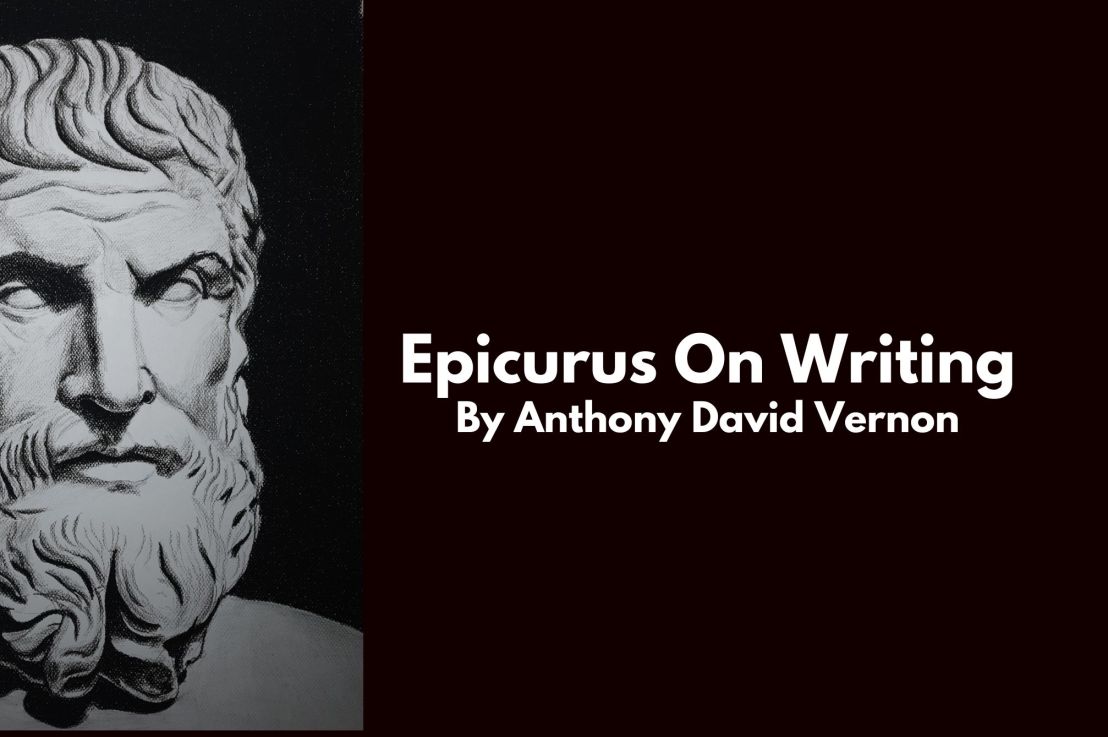
Epicurus is perhaps one of the most misunderstood philosophers and writers. He was a man of simple pleasure mistaken for a hedonist, and his writing resume is usually reduced to one work, The Art of Happiness. This is partly because the vast majority of his work did not survive, but “Estimates claim that Epicurus wrote over 300 works during his lifetime.”[1] Nonetheless, this all has led to Epicurus being an underestimated writer. But, Epicurus, in the fragments we have from him, presents quite useful pieces of writing advice.
Epicurus speaks to his writing, stating, “I write this not for the many, but for you; indeed, each of us is enough of an audience for the other.”[2] Epicurus points out that writing is always between the writer and a single reader. Too often, writers focus on a potential mass of readers instead of focusing on the fact that is is always one reader engaging with a work of writing. Even if a work of writing is being read aloud to a crowd, each reader is having a personal engagement with a given piece. When writing, imagine that there will only be one reader of your work, this will allow your writing to be more intimate. For Epicurus, writers are too concerned with having mass appeal and so lose out on emotionality. This is not to say that writing for one person cannot appeal to the many, quite the opposite, personal works possess personality.
The above quote from Epicurus also teaches another writing lesson: a writer should be happy that they have readers at all instead of being worried that they do not have enough readers. As the proverb sometimes goes, expectation is the thief of joy, and writers often suffer from expectation. Having a quantity of readership expectations can kill the writing process because it shifts the writer away from the joyful intimacy of writing into mass expectations that can never be actualized. A writer can never fully know who their readers will be or how their writing will be interpreted. Thus, a writer at any level should write with the satisfaction of knowing that they even have the potential of having a single reader.
Epicurus also states, “Writing presents no difficulties to those who do not aim at a constantly changing standard.”[3] What Epicurus means by this is many-fold, but for one, Epicurus is advising writers not to worry about writing trends. For Epicurus, it is more important for a writer to hone in on their style rather than the style of the day. If one writes as themselves, they will not struggle to be as themselves. Meanwhile, it is a struggle to fake a writing style that is not one’s own to wear sheep’s clothing.
In addition, for Epicurus, writing should be an act of personal ease, not an uphill battle, but instead a demonstration of a self-constant standard. This means that writers should not set shifting goals but instead aim for one simple goal. What this goal is depends on the writer. However, a writer should pick a goal that at least rarely shifts and ideally is a constant.
Likely, a great deal of writing wisdom was lost among Epicurs’ missing works. Still, what we hold from Epicurus is extremely limited, it holds depth both mentioned and not touched upon. This is part of the greatness of Epicurus; a writer can dig for inexhaustible writing advice from Epicurs with examination.
[1] https://www.thecollector.com/epicurus-on-the-values-of-family-and-friendship/
[2] https://marxists.architexturez.net/archive/marx/works/1839/notebook/ch05.htm
[3] https://www.attalus.org/translate/epicurus.html

Written by Anthony David Vernon
Author’s Bio
Anthony David Vernon mainly writes poetry and philosophical articles when he is not walking trails.
Education:
Publications & Prizes
Anthology:
Faery Flying: The Art of Self Care (Fae Corps Publishing, 2023)
Book:
The Assumption Of Death (Alien Buddha Press, 2022)
Journals:
Apocalypse Confidential
Beautiful Space: A Journal of Mind, Art and Poetry
Conceptions Southwest
Synchronized Chaos
The Drabble
The Literary Yard
Unlikely Stories
ZiN Daily
Prizes won:
Pushcart Prize Nominee 2022 for “Guilt is a Pleasure” nominated by Alien Buddha Press






 Wild Ink Publishing