Tag: poem

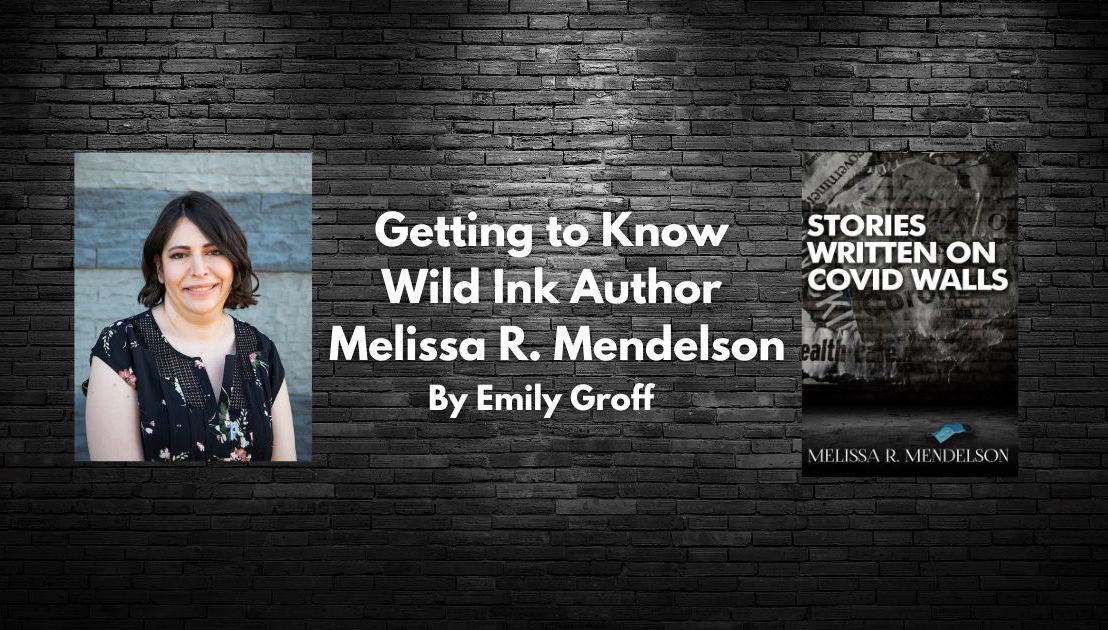
Getting to Know Wild Ink Author Melissa R. Mendelson

Getting to Know Wild Ink Author Melissa R. Mendelson

By Emily Groff

We write because there is nothing else that touches our souls or our hearts, the way the written word does. Words of every language are printed on paper and are grasped by millions around the world.  We write what we feel, and we authors can only hope it connects with others and helps them think, cry, and mend. No matter how much or how little we write–one word, one sentence– we are writers.

Author Melissa R. Mendelson writes because she loves it. She writes because she can express herself and her emotions. She writes to become the most vulnerable version of herself that she can be. Although Mendelson works as a full-time Administrative Assistant for the State of NY, she writes when she comes home from work and spends her weekends with pen and paper in hand. Working as an Administrative Assistant is tiring, forcing her writing after work to be brief, but it is on the weekends that she saves her energy and writes, entering into another world of her own.

Mendelson has had numerous stories and poems published. Our favorites, UnCensored Ink: A Banned Book Inspired Anthology; Ourania’s Orrey of Imagination; I’m Not The Villain, I’m Misunderstood; Calliope’s Collection of Mystical Mayhem. While all these publications draw us in, we are excited about Stories Written on Covid Walls, especially. Meet Melissa R. Mendelson and her new short story collection, Stories Written on Covid Walls.  

(Picture of Stories Written on Covid Walls)

1. Tell us what your book, Stories Written on Covid Walls, is about.

During the pandemic, when I wasn’t writing poetry, I was writing short stories involving the pandemic that ranged from dystopian to drama, and touched on a lot of topics, including family, loss, depression, and anger.

2. What made you want to write in poetry? Do you find poetry more compelling?

Writing, for me, is how I express my emotions, how I let them out. A lot was going on in 2020 with the pandemic with my infertility, and my family. If it wasn’t for writing, I don’t know how I would express how I really feel inside.

3. How do you get the idea to write these books/poetry collections?

During the pandemic and my infertility, I needed a way to cope, so my way of coping was writing both poetry and short stories, switching back and forth and back and forth depending on how I felt and what was going on in my mind.

4. Is there a common theme or genre that you tend to write in? Why that specific theme or genre?

I’ve always leaned toward Dystopian, and it’s fitting with everything going on right now. I don’t believe in happy endings, and when I pay attention to what is going on around me, I see the dark side of it.

5. When did you first begin writing and what got you interested in writing?

I had two great seventh grade teachers that believed I was going to be this talented writer, and it took some time for me to see that.  But in high school when I was dealing with family issues and bullying at school, I buried myself in my notebooks.  I was writing short stories like Lizardian and Porcelain and I was writing really dark poetry.  Luckily, my poetry is not that dark anymore, but some of my stories are.

6. What is your writing process like? Do you have any particular tips, methods, or writing strategies that help you?

I try to budget my time, especially in the evenings and weekends.  If my energy is low, then I aim to do small projects, work on ten pages, maybe write a page or two, and get myself going.

7. Tell us more about you!

I love taking pictures.  Other than being an author and poet, I am a photographer, and at some point, after I complete some projects, I would love to focus on that and try to get my pictures out there.  Right now, I use a lot of them for my website and match them to my stories and poetry.

To learn more about Melissa R. Mendelson, visit her website: https://melissamendelson.com/

Getting to Know Wild Ink Author A.M. Hayden

Getting to Know Wild Ink Author A.M. Hayden

By Emily Groff,
WIP Literary Analyst

A.M Hayden does it all. To her students at Sinclair College she is a professor. To her family she is a mother and wife. To her home community she is a farmer. To us, she is an author.

“Naps are the glue that holds my life together,” said Hayden.

Hayden has previously published a full-length collection of poems titled American Saunter: Poems of the U.S. and had begun to work on a second full-length collection depicting her travels in Europe. This collection came to a halt after a family visit to South Carolina. This is where How to Tie Tobacco began.

1. Tell us what How to Tie Tobacco is about.

During my trip to South Carolina, I was hearing all the stories told, and I just couldn’t stop thinking about them, and knew there were poems in them. I started taking notes on my phone on the drive back, and then when we got home, I wrote a draft for How to Tie Tobacco within 3 weeks. It’s the fastest I’ve ever written something.  It just all felt like it fell out, just coursed right through me, in several forms of poetry and prose, all inspired by stories, photographs, and handwritten notes from my southern grandmothers, great-grandmothers, and other matriarchs of the family.  Hearing all their humorous tales, life’s trials and tribulations, I was in awe of the strength the women in my family had/have.

2.  What made you want to write in poetry? Do you find poetry more compelling?

I have always loved to write poetry, ever since I was a kid.  I think watching Dead Poets Society at around 11 years old not only made me want to be a teacher, but also solidified my love of poetry and gave me the passion for it. 

Through poetry I feel I can reach further, stretch beyond the horizon, get to those spaces in between, expressing these connections and emotions with a different kind of freedom from academic teaching and writing.  The forms, style, and subject matter of my poems vary. However, they share a passionate commitment to observe, to sit still and listen, to learn, to make connections, and to express what it is to breathe, live, and engage with life in all its diverse formations, to cultivate a new, widened perspective of the natural world and the diverse people in living in it.   Poetry is pure expression and allows me to create and contribute in a way nothing else quite does. 

3. How do you get the idea to write these poetry collections?

I call this the “Antenna.” I think listening/paying attention for the spark/imagery/idea is such an important part of it. And for this, we’ve got to quiet some other things down sometimes, which can be difficult.  So much of my poetry often comes to me while I’m driving or right before bed.  I love embracing the entire process, from this “receiving” or “collecting” I sometimes call it, then the piecing together, the story building, finding the right form/format/container, the polishing/editing, and finally, the reading out loud and/or performing/publishing the piece. I feel like there’s so much sacred energy and fulfillment in both the culmination, but truly, also the magic of the process. I love how Mary Oliver says writing is two parts: 1) Magic Spirit Experience 2)The Practice/Craft. I really agree with this.

As far as content, the focus for me the last few years has been getting into writing all the traveling I’ve done. But, I also love to write about nature and my dog and pretty much everything! I love stories and getting into the marrow/authentic mojo of someone’s experience.

4. Is there a common theme or genre that you tend to write in?

Definitely the “travelogue” style so far, but I will be expanding as I’ve got a lot of books in me on a lot of different subjects. The courses I teach — Philosophy, World Religions, Environmental Ethics, and Native Studies —also significantly influence my work. I enjoy rooting in these themes when writing, engaging respectfully with different views, examining our assumptions, cultivating mindfulness of history, sacred space, ritual, ceremony, architecture, music, art, etc., ultimately understanding each other, and ourselves, better.

5. When did you first begin writing, and what got you interested in writing?

I received a diary at Christmas when I was five (from one of the southern aunts, serendipitously enough!) and that’s when I began writing…and never stopped.  Also, I LOVED my little rural library. It was just a little old building with green carpet, very 70s, and had a musty, old book smell, which I loved and I remember getting so excited to pick out a few books for each weekend, sometimes reading my favorites over and over again, a lot of Beverly Cleary and Judy Blume.

6. What is your writing process like? Do you have any particular tips, methods or writing strategies that help you?

  • Listen for and pay attention to inspiration
  • Trust your instincts/intuition with what comes to you
  • Make room in your brain for the writing and editing
  • Write, send the piece out, let it go. Rinse, repeat.
  • Do not give up!
  • Be kind and open to rejection or feedback.
  • Don’t be afraid to write in form.
  • Write down your ideas all the time–even if on a napkin!
  • Allow for stillness and observation–don’t miss the inspiration!

7. Tell us a fun fact about you!

I have many rescues, including rescue pigs, goats, chickens, two dogs and two cats.  Our two dogs are both special needs – one is completely blind (has no eyes) and only has three legs and the other is completely deaf and mostly blind. They are both amazing dogs! I also REALLY love El Caminoes and dream of having one someday.

Purchase How to Tie Tobacco here.