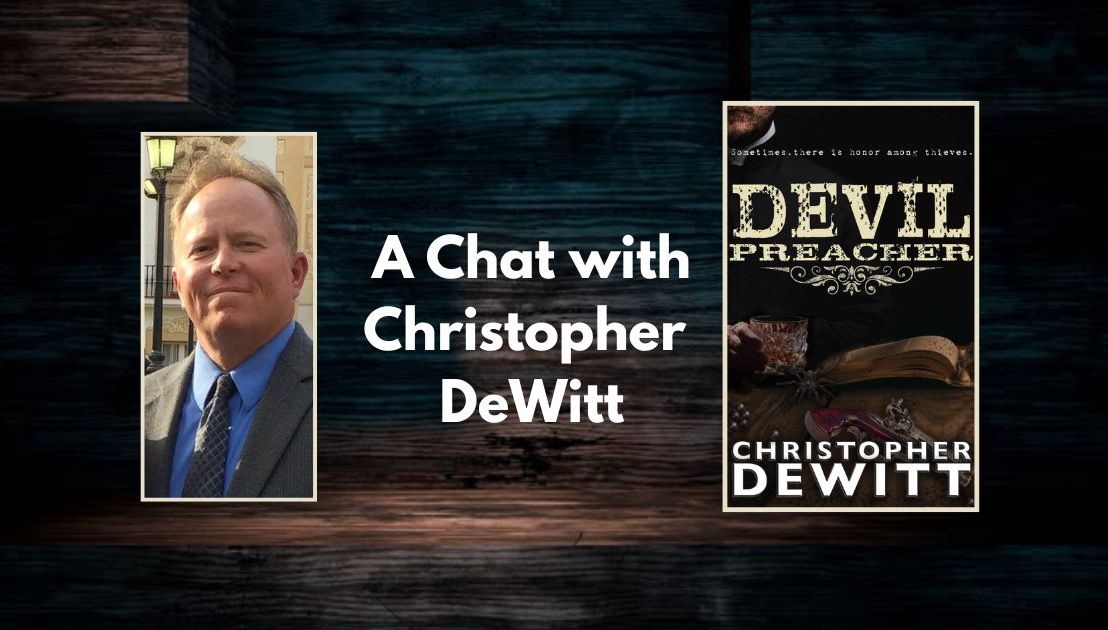
What sparked the idea for Devil Preacher?
I’ve been a fan of Louis L’Amour paperback westerns since my dad introduced them to me when I was a
kid. There was a rather throw-away line in one of them referencing this character John Murrell and how
he wanted to set up his own empire within the American south. The idea intrigued me right away and I
started researching the story. The more I researched, the more fascinating it became, and I thought it had
the potential to make a good novel.

How do you approach writing on days when inspiration feels thin?
I usually will try to jump-start myself by reading what I had written during my previous session. Something
I am sure most writers do, to sort of “keep me in the loop.” As I am reviewing, I will tweak a few things
here or there and that seems to prime me to continue a scene or attack the next one. If I really have no
gas in the tank after all of that, I find that even if I can set a paragraph or two down, I call it a success. I
may scrap the whole thing the next day, but even that process can generate some productivity.
What part of your book changed the most during revision, and why?
I would say the third act, primarily because as part of the editing process the characters had developed
more and had more agency. It was a really rewarding experience.
What do you hope readers carry with them after finishing your work?
Devil Preacher is really about friendship, and how deep our loyalties can go, even beyond death. So, I
would hope readers will reflect on their own lifelong friendships and how much those people have affected
their lives and how much they mean to them.
Is there a scene or moment in the book that feels closest to your heart?
The scene where Stephen leaves his home, being sent away to a boy’s home, and the interactions with
his parents and his sister in those last moments before departing. His father silently just wiping a tear
from his face, then squeezing his shoulder, and of course his mother bending down to hug him and he
smells her lilac soap and knows that smell will trigger memories for him in the future. I thought of my
parents, of course, when writing this, and I hope it reads as emotional as it felt while I was writing it.
What book or writer shaped your voice in a way you still notice?
It’s tough to pinpoint a single writer or book, there are far too many, but I’ll give it a go… I’ve always loved
historical fiction and C.S Forester was the earliest influence on me with his Horatio Hornblower series. Of
course, there is plenty of 18 th century naval action, but I loved how his main character was not an instant
action hero. He is uniquely flawed, filled with self-doubt and has plenty of his own quirks. It made him so
much more real to me. I’ve read those books multiple times over and I’m still in awe of how Forester could
write such readable stories where the reader feels connected with people and events from hundreds of
years ago.
What are you working on now, and how is it taking shape?
The working title is The Watchers Within and it deals with a war between the Watchers – fallen angels
and how they interact and affect human beings in the modern age. It really is a story about the nature of true courage and self-determination as well, but I can’t say too much without veering into spoilery territory. It seems to be coming together rather well, and has, I think, become a richer and more layered story along the way. It’s been quite fun, so far!
Purchase Devil Preacher here: https://a.co/d/7jyNvZ8

Christopher DeWitt lives in Phoenix, Arizona with his wife Christine, son Alex, three dopey but lovable dogs, and a weird, vegan cat. When he isn’t writing and reading, he is exploring the beautiful and sometimes eerie Superstition Mountains and the haunts of Tombstone. He also occupies his free time trying to figure out if his house, built practically on top of old western mines, is as haunted as The Copper Queen Hotel in Bisbee, Arizona. (It is.) A United States Air Force veteran and licensed pilot, he loves anything that flies and earth-bound racing machines that go very, very fast. He is an incorrigible and unapologetic Godzilla and Star Wars geek and loves to read history, historical fiction, westerns, sci-fi, and horror.










 Wild Ink Publishing