Tag: Author Interview

Spooky Season is Upon Us: An Interview with Greg Jones

Spooky Season is Upon Us: An Interview with Greg Jones

by Bruce Buchanan

Not every good fright comes from phonebook-length novels. Horror poetry can deliver goosebumps and jump scares in just a few words.

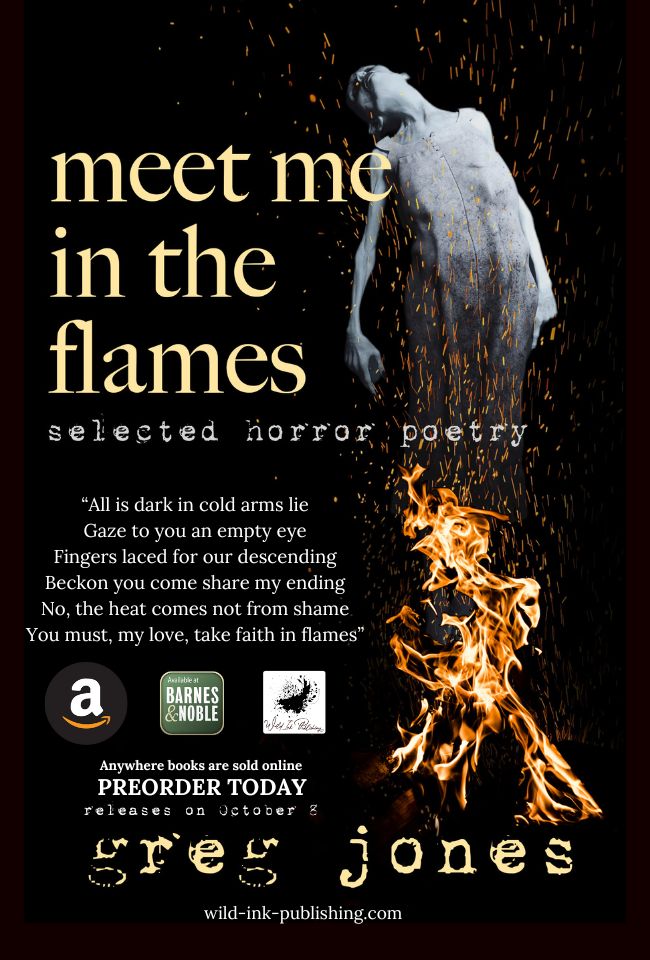
Take “Meet Me in the Flames,” an upcoming collection of dark poetry written by poet/author Greg Jones. In this Wild Ink Publishing collection, Jones not only taps into inspiration from such legendary horror authors as Edgar Allen Poe, H.P. Lovecraft, and Clive Barker, but he also draws upon the movies, comic books, music, and TV shows of his childhood.

The result is a tantalizingly terrifying book of poems.

1. Tell me about the stories and art that inspired you (or maybe gave you a scare!) growing up in the ’80s. What types of books/art/movies/music, etc. were you into?

I was fortunate enough to have parents that weren’t too strict on the content I was consuming. In this day and age, maybe social services would have been involved, but this was the 80’s. Anything went.

We were the first family to have a VHS player so our house was very popular. I grew up with John Carpenter, Wes Craven, early Spielberg and Lucas. I still remember seeing the second Friday the 13th at the drive in and having my dad move the car when I went to the bathroom. Saw Jaws when I was 7. The Thing blew me away. I think The Howling is the best werewolf movie ever made. I was seven when Star Wars came out. Ten for Empire. What an absolute perfect time to be a little boy.

The comics that were being published were incredible. Springsteen was on the radio. I would tape Spider-Man cartoons and Dr. Demento shows on my Kmart cassette recorder and listen to them until they wore out. My first concert was Weird Al.

I am still basically 12 years old. You ask me what inspired me back then?  Everything was an inspiration.

2. Why do people love horror so much? What is the appeal of a well-written scary poem or story, in your opinion?

What do we do right after we get scared and scream? We laugh. It’s a release. I think that is a big part of it . People like being scared and taken out of their comfort zones. They like being titillated. It’s fun.

If you can write a scene where people have to turn away or put their book down and turn off the light, you have achieved something. If you can elicit an emotional response like that with just the words you have written, not with images and sound and effects, but just words? That’s amazing.

I love reading something and then going back and reading it again because I couldn’t believe it the first time around. When you say “wait! Did I just read that?” And do a double take … that is a gift. That is what I strive for.

I posted a poem online a while back and someone commented simply” Wow”. I coasted on that one-word review for quite a while.

3. You recently wrote about meeting legendary author Clive Barker. What was that like, and what did it mean to you?

That was definitely a highlight reel moment for me. His appearance announcement came within minutes of me getting my first proof of cover art for “Meet Me in the Flames” so it seemed like fate. I have always been a big believer in giving credit where credit is due and if it weren’t for his writing and my discovering him at such a pivotal time in my life, I might not have ever had the desire to do this.

Books that were being written before he came on the scene were pretty tame and somewhat formulaic. I enjoyed them at the time, but his stories were so much richer and more imaginative and really kicked the door open for me as to what could be done in the genre.

Meeting him was a full circle moment for me. I know I will probably never have the chance to see him again but knowing he has samples of my writing and that we were able to have that interaction 20 years after we first met means the world to me.

When my collection is published, I plan on sending him a copy. Just knowing that my words might be sitting on his shelf somewhere makes all of this worthwhile.

4. What is your writing process like? Is there a certain place or time in which you like to write? And is your process different for poetry versus prose?

I’m not sure if I actually have a writing process. I pull inspiration from things I hear or see or phrases and words I come across. Something that may start out as a more tongue in cheek idea may morph into something more disturbing or creepy. It all depends on where my mind takes me. It sounds cliche but it’s the truth. It’s a lot of stream of consciousness type of thing.

I have a desk in my basement that I write at or I’ll go to a coffee shop for a few hours but mostly it’s on my phone for convenience sake. There is a list on it of ideas and fragments of ideas and poems that I have gotten to a certain point and may revisit in the future. I don’t discard anything because you never know when a thought might be recommissioned into something you never even imagined when you wrote it.

It’s fun to challenge myself to come up with new things or expand ideas into longer pieces. Eventually I would like to rework some of these into short stories to go along with story ideas I already have brewing. I don’t know if I have a novel in me but definitely a short story collection.

5. “Meet Me in the Flames” is your first book. What made you decide to do a book of poetry? And how did it come together?

I found myself a few years ago recuperating from a torn tendon in my arm and with some free time on my hands. I was into some newer Americana and folk music at the time and started writing songs with the intention of learning the guitar. A few good things came out of that but eventually, like most things, my attention started drifting toward darker material and the horror poems were born.

I had a goal to reach 100 poems and if I could hit that and have some content I was proud of I would submit them somewhere as a collection. I googled who was taking submissions and Abby at Wild Ink asked for a sampling since she was looking for a horror title to print. She loved the samples, asked for the rest of the collection and I found out she was interested in publishing them around the beginning of 2024.

I’ve been constantly writing and am working towards an even stronger second collection of poetry before trying my hand at some short stories.

6. How did you find Wild Ink Publishing on your writing journey?

This whole journey has been very surreal. I have heard of the trials and tribulations of getting published but honestly, I was not too keen on going the self-publishing route. I wanted the affirmation that goes with someone reading your work and saying “This is good enough that I want other people to read it. I believe in this.” That is what I have experienced with Wild Ink.

I realize how uncommon this is and I am extremely grateful for the opportunity. Everything right down the line has been handled with extreme professionalism and care and the fact that I still feel like this is MY book and it hasn’t been corrupted by someone else’s vision or agenda is the best take away so far. The community of creative people involved have been encouraging and attentive from the very beginning and I hope that other aspiring authors have the opportunity to get their work published in much the same manner.

7. I understand you also did the illustrations for this book! That is so cool – how long have you been drawing?

For as long as I can remember. I have always been a comic book fan from a very young age and spent my childhood reading, collecting, and drawing as much as humanly possible. I would spend hours hunched over a drawing table or any flat surface really and study techniques and anatomy and storytelling. I am proud to say that I am completely self-taught and everything I know how to do artistically came from those years.

I have had aspirations to be a comic artist, but it is a very hard field to break into, especially pre-internet and growing up in the Midwest. I still have a dream to write and draw my own comic and have the story all fleshed out so maybe sometime in the future we will be having a conversation about that.

Between the comics, the movies, the music, and the general carefree nature of the world during those decades, it was a hell of a fun way to grow up.

Preorder Meet Me in the Flames here: https://www.barnesandnoble.com/w/meet-me-in-the-flames-greg-jones/1145985867?ean=9781958531853

Interview by Bruce Buchanan

Bruce Buchanan is the communications writer for an international law firm and a former journalist. But he’s been a fan of fantasy and heroic fiction for most of his life. His influences range from the novels of Margaret Weis & Tracy Hickman and Terry Brooks to the Marvel Comics stories of Stan Lee, Jack Kirby, and Steve Ditko. Bruce has short stories appearing in the upcoming Wild Ink Publishing anthologies Tenpenny DreadfulsClio’s Curious Dash Through Time, and UnCensored Ink. He lives in Greensboro, N.C. with his wife, Amy Joyner Buchanan (a blogger and the author of five non-fiction books), and their 17-year-old son, Jackson.

An Interview with K.M. King

An Interview with K.M. King

By Bruce Buchanan

K.M. King has worn many hats—she’s been a journalist, a teacher, a business owner, a corporate trainer, a student of history, and a member of the U.S. Army.

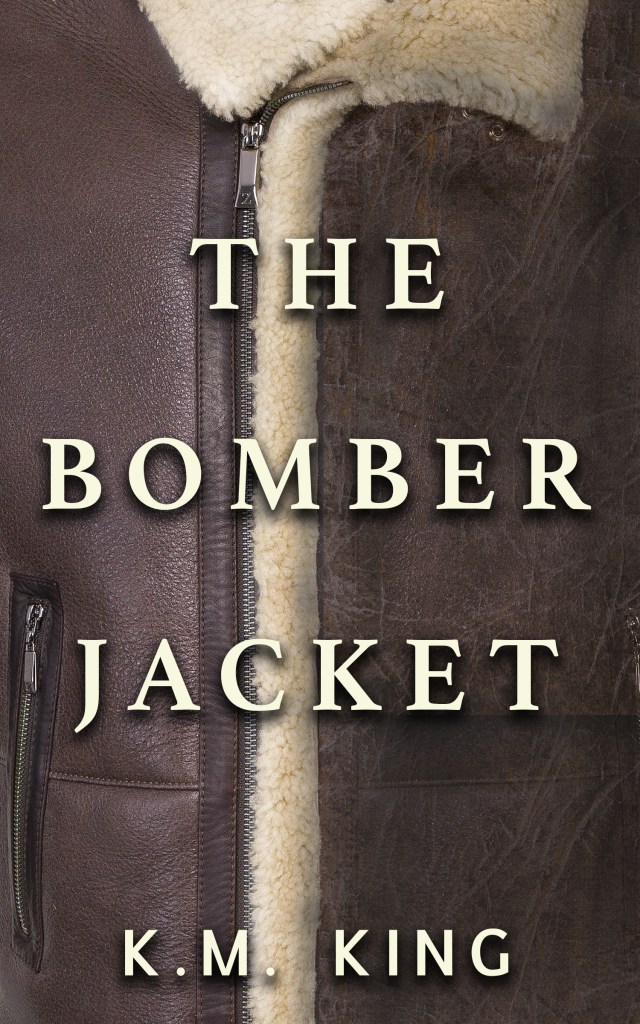
She recently added one more line to her already impressive resume—Wild Ink author. Her novel The Bomber Jacket will be released on Aug. 20, 2024.

K.M. King has worn many hats—she’s been a journalist, a teacher, a business owner, a corporate trainer, a student of history, and a member of the U.S. Army.

When an American college student buys a World War II vintage bomber jacket, it sends here on a search to learn more about its original owner. Along the way, the veil between past and present becomes ever thinner.

You’ve said you fell in love with reading at a young age. Did that also extend to writing?

I always loved reading stories and creating stories in my head. The first writing I remember doing outside of schoolwork was in the little pink diary I got as a Christmas present in fourth grade. All through school, I was involved in writing for our school papers and was editor of our high school newspaper in my senior year. I loved all the writing assignments for English class. I had a hard time deciding whether to study English or history in college—history won.

As for writing fiction, that didn’t happen until I was in my mid-twenties. I was taking some business classes at a local college and signed up for a fiction writing class. I wrote a short story and got great feedback from my professor. The rest, as they say, is history.

It sounds like you’ve had some amazing career and life experiences. How have those experiences shaped your writing?

That’s a challenging question to answer. I think for me writing is so ingrained in who I am, I’m not always sure I can parse out what influenced my writing. Every job I’ve had involved writing, whether as a teacher, journalist, non-profit publication specialist, personal coach, or creator of staff development curriculum.

I’m essentially an introvert—like a lot of writers—and very self-reflective. I almost minored in philosophy in college. My journal, which I’ve kept from my early thirties, provides a space for me to ponder the inexplicable mysteries of life. I think I ponder those same mysteries in my fiction, through my characters, hoping they’ll give me the answers I haven’t found elsewhere.

How did the idea for The Bomber Jacket come to you?

I’ve always been fascinated by flying. Probably should have joined the Air Force instead of the Army! When I was stationed in Frankfurt, Germany, I used to go to the Frankfurt Airport and watch the planes come and go. Something about that planted the seed of a story about a pilot.

In 1997 and 2004, my husband and I took trips to Scotland, and among the places we visited was Drem Aerodrome, a former Royal Air Force base near Edinburgh. That seed, which lay dormant for more than two decades, sprouted into a Scottish bomber pilot from World War II. I began reading extensively about the RAF, and the characters crystallized during a trip to Scotland in 2011 with our oldest granddaughter, Zoe, who was 11 at the time.

I’m also interested in the idea that the veil between the past and present could be very thin. Spirits and ghosts have always fascinated me, and the possibility that spirits linger among us until they’ve completed whatever unfinished business holds them here helped shape the novel.

I am documenting the whole process of writing The Bomber Jacket on my website: www.kmkingauthor.com.

Were you interested in World War II history before you started this book?

Yes, definitely, both because I was a history major, and my father served in the Army in World War II. Like many of his generation, he never spoke about his experiences, except for a few succinct statements here and there when he was older. I’ve been reading World War II fiction and non-fiction for years and share my enthusiasm for history of all eras with my husband.

You’ve written other novels. What has been your biggest challenge in writing? And how did you ultimately overcome it?

I think my biggest challenge is I don’t just write in only one genre. I started writing novels in the early 1990s—a series of young adult fantasy books. Wild Ink is publishing the first of them, Jenna’s Journey: The Bronze Key in January 2025. I wrote The Bomber Jacket next; it’s World War II fiction.

I’m currently working on a three-book rom-com series with fantasy elements. I also have a mother-daughter generational story half-finished and the skeleton of an idea for a comic novel about a woman who gets obsessed with K-drama and K-pop. Nothing biographical there at all! 

I’ve yet to overcome this challenge.

My other challenge is imagining my books might attract the interest of a publisher, especially after 45 rejections in attempting to find an agent for The Bomber Jacket, let alone a publisher. I am astounded and incredibly gratified that Wild Ink has seen something worthwhile in my stories.

Getting published was always a dream, not a motivation for writing if that makes any sense at all.

What is your writing process like? And how has it evolved?

I have to say, my process is different for different kinds of books. But for every book, the motivation is the same: I have questions about life, about an experience I’ve had, about someone I’ve known, and I write to find the answers to those questions by giving them to my characters to grapple with. I don’t always like the answers they come up with; sometimes, I’m not even sure what question they are working out in their story. I often discover it when they do, sometimes at the end of the first draft.

With Jenna’s Journey, the story simply appeared, and I wrote it when it did. There were long periods of time when I didn’t work on it, except to edit what I had written. No wonder it took me ten years to write the four books.

With The Bomber Jacket, I did extensive research, character development and plotting, but still the characters sometimes did things I didn’t expect them to. Or the story took an unexpected twist or turn.

For all the books I write, I first tell myself the story. That’s the first, second and third draft. When I am satisfied that my characters have answered my questions, even if I don’t like their answer, then I’m ready to consider sending the story into the world and work with an editor or a writing group to hone it.

What tips would you give to new or aspiring writers?

I still feel like a new and aspiring writer, because every book is a new adventure and has its own unique challenges.

I’ve read and continue to read books on writing. I think some of the advice is awful. One famous writer, who shall remain unnamed, said unless you write every single day, you’re not a writer. Hogwash. Writing is unique to each writer– the process, the purpose, the story to be told. Discover what works for you.

I have learned that very often the first several chapters of a first draft are the backstory—what the writer is telling him/herself about the story. Finding where the story actually begins for the reader can take some work.

Also, work on your book for a while, have at least 75 pages or more written, and then join a writers’ group, but one with serious writers who give valuable and supportive feedback. Or find a developmental editor.

Anything else you want to mention, either about yourself or your novel?

I also teach journaling workshops and have written two workbooks which will soon be available on my website: Pen, Power & Possibilities: A Guided Journaling Experience to Expand the Horizons of Your Life and Time: Tyrant or Treasure: 11 Steps to Embracing Life in All Its Messiness.

Preorder K.M. King’s book, The Bomber Jacket, through Aaron’s Books here.

Interview by Bruce Buchanan

Bruce Buchanan is the communications writer for an international law firm and a former journalist. But he’s been a fan of fantasy and heroic fiction for most of his life. His influences range from the novels of Margaret Weis & Tracy Hickman and Terry Brooks to the Marvel Comics stories of Stan Lee, Jack Kirby, and Steve Ditko. Bruce has short stories appearing in the upcoming Wild Ink Publishing anthologies Tenpenny DreadfulsClio’s Curious Dash Through Time, and UnCensored Ink. He lives in Greensboro, N.C. with his wife, Amy Joyner Buchanan (a blogger and the author of five non-fiction books), and their 17-year-old son, Jackson.

An Interview with our Editor-in-Chief

An Interview with our Editor-in-Chief

Abigail here! Brittany McMunn and I talked daily. Truth be told, she’s probably tired of me at this point. But she humored me for this interview. I’m currently teaching a course on editing and coaching for the SNHU MFA program, and I knew she would have some amazing insights to share with my students. She did not disappoint.

Here’s the interview…

What brought you here?

Since my hair-brained idea at the start of 2021 to change my MHA a year into the program to something I was more passionate about, my MFA journey has been one of the best things I’ve ever done. It provided me with a creative outlet and gave me back a sense of identity I had lost after running up the corporate mountain, being a wife, and a mother for more than a decade prior. But most importantly, it gave me the structure to help others find their kernel of success, whatever that may look like for them.

I was recently asked to interview for MFA students at my alma mater and there was no way I was going to turn it down!

What made you decide to start editing?

I’ve always had a keen eye for the small details. However, editing is more than just picking out the errors & opportunity gaps in craft; it’s about bettering the other person. I love to teach and learn, and editing provides me with both of those things in droves.

How did your coursework with SNHU’s MFA program help you achieve your goals of editing?

The MFA program at SNHU gave me structure and intention. The things I was editing before SNHU were based more on the stylistic choices I had as a reader than on what was foundationally appropriate for the context and material. SNHU gave me the confidence to build a business on my knowledge and provided me with the framework to understand industry terms, inner workings, and methodology. 

Do you do freelance work or do you work for a publishing company? 

I started out as a freelance editor through an LLC I started while in grad school. I have since taken on a position with Wild Ink Publishing as a managing partner & editor-in-chief as well as launching my own publishing company, in collaboration with Wild Ink, in May of 2023. I still offer freelance work as pro bono editorial assessments one, because I just simply love it, and two, because I not only feel I have a lot of knowledge I have a passion to share but because I learn so much in return.

What skills are necessary to become an editor?

Editing requires both technical and personal skills in equal measure. As a role that puts you directly in the path of another’s persons creative vision, you not only have to be versed in the subject matter and know where to research topics if you are unsure but you also have to contain very healthy levels of empathy, compassion, and the ability to listen. Editors are very technical and analytical individuals, but don’t forget edges blur and not everything is going to fit into a predefined box the industry has created for it. 

What is most important to remember when working with authors?

Authors are artists, and just like any artist, their vision is their own. Regardless of whether an editor agrees with it or enjoys it, it is their job to ensure that vision is conveyed in the most accurate and clearest way possible. Take their soggy sand castle and build a metropolis of brick and mortar. 

Which type of editing do you prefer and why? 

For me, it depends on the genre. I am an emotional reader, so any genre that causes me to feel something at my core is my favorite to developmental edit. Those genres that I wouldn’t pick up and read for pleasure, such as literary or science fiction, are the ones I prefer to line edit. It is easier to separate myself from the content and focus on the technique of the writing if I’m not immersed in the story so deeply that I overlook the grammatical and syntax opportunities. 

You are an Editor-in-Chief; what does that mean? What do you do in that role?

It means everything that goes array is my fault. Okay, not literally, but a lot of it. As an EiC, I have final approval of all material content, formatting, and typesetting that leaves the safe haven of the publishing company before it enters the world for mass consumption. Editing is not a one (wo)man show as there is a whole team of freelance and staff editors who I must ensure remain on schedule with the publishing projects. Publishing timelines are set approximately 1 year in advance, so it is imperative that delays do not happen unless otherwise unavoidable so as to not cause a horrendous domino effect to the other dominos in layout, formatting, cover design, publicity, etc. I also set the timelines for editing based on genre and word count and provide the second set of eyes when or if an author does not agree with another editor’s critique. 

What should MFA students know about the publishing business?

The publishing industry is exceptionally saturated, more now than ever. Thank you, BookTok. This means standing out like the Mount Everest of Zits through continued and persistent efforts and a unique style/tone is what it’s going to take to be recognized. Agents and publishers are very particular about what they will accept because they want to ensure it sells successfully in accordance with market trends.

However, that being said, there are new agents and publishers coming onto the scene just as quickly as authors right now. There is a perfect fit for you and your story; just remain true to yourself and keep at it until you find your path. Whether that path is traditional Big 5 publishing with an agent, indie publishing with self-representation, or self-publishing; all of these avenues have shown to bring authors immense success. Do not let the lack of immediate success or overnight stardom deter you from writing and putting your creative vision into the world. You will find fulfillment in your efforts by the level of investment you put into it. 

Brittany McMunn

Author | Editor | Writer | Entrepreneur

Brittany has been an avid reader since before she could remember. The dusty bounds bought from local flea markets and thrillers lining her grandmother’s bookshelves were her place of peace as a child.

As an editor with a deep passion for helping writers achieve their dreams, Brittany saw the need novice writers had for someone to assist them in refining their works. This need is what drove Brittany to create an online writing community for MFA students aspiring for publication, as well as branching out into freelance editing through her LLC, The Paraphraser.

Brittany has an undergraduate degree in communication and has earned her Master of Fine Arts in Creative Writing, as well as being a member of the Sigma Tau Delta English honor society. Brittany enjoys genres such as paranormal, fantasy, contemporary, thriller, and young adult fiction all with heavy romantic elements.

Meet Your Heroes!

Meet Your Heroes!

by Greg Jones

I’ve heard it said to “never meet your heroes.” However, there are certain people who impact your life in such a profound way that it would be a disservice to yourself and to them if you didn’t seek them out when possible to have the chance to maybe engage on a more personal level. I personally believe, in this ever-distancing world, that these encounters are more important now than ever.

A literary hero might be the most elusive of all.

I had the good fortune of meeting Clive Barker at a Harry Schwartz bookshop in Milwaukee about 20 years ago. It, to this day, plays on repeat on the highlight reel of my life.

To say he is a major influence in my life is a vast understatement. At 14, when I first read his short horror fiction, I knew this was something unique and special. His writing brought poetry and elegance to a genre that was sorely lacking in those qualities up to that point. It has influenced and inspired my art and my writing ever since.

To those not familiar with Mr. Barker, he was very prolific in the 80’s and 90’s, moving from horror to dark fantasy to full adult fantasy novels. In 2012 he fell into a coma after a dental procedure left him battling toxic shock syndrome, which has affected his health ever since. He recently posted that he would be doing a handful of personal appearances throughout 2024 and then focusing entirely on various unfinished projects.

This news came the same evening as my final cover reveal for my upcoming horror poetry collection from Wild Ink. I learned that he would be coming to Chicago at the end of March and I made arrangements to make the trip.  

I arrived at the convention center with a framed photo of the two of us from that first Milwaukee meeting as well as a binder containing a selection of my strongest poems, a copy of the cover art for my book and an emotional letter explaining what a profound effect he has had in my life. Two hours later we would meet for the second and, most likely, last time.

He shook my hand and said ‘’Hello” and I was taken aback at the frail man before me. It was emotional to say the least.

I showed him the photo of the two of us and he commented how we were both “children” back then. We reminisced on the picture and then I asked him if I could give him something. I handed him the folder and told him about the pending publication and that it would not even exist if it weren’t for him. I could see he was affected by this and he shook my hand again.

He leafed through the pages and asked me how long I had been writing poetry and “why” I had started writing. Again I told him “because of you.” He said he was honored and actually asked ME to autograph the sampling for him. I was astounded. It was surreal as I signed my name to a dedication to him!

He asked my wife if she was proud then asked her if “I” was proud, to which we both responded, absolutely. He ended by saying what a huge accomplishment this was. Before I left I shook his hand again and told him my contact information was included inside and if he ever felt the urge to send along any words of encouragement or advice I would be forever grateful.

I left deeply moved and affected and filled with many feelings. Validation, pride, hope, and a bittersweet sadness knowing this might be the last time I ever speak to him. It was a complete full circle moment for me and I am beyond grateful for his words and attention and just for being the genuinely decent human being I remember from 20 years before. I hope on some level it meant as much to him as it did to me.

I have been fortunate enough over the years to meet or have interactions with many of the people I look up to and respect. It is a gift to share these moments with individuals who have moved or inspired you and I would encourage anyone to take that chance if it presents itself.


Born in 1970, I grew up,  in my opinion, in the pinnacle of all things. The best films, music, comic books and those fantastic 80’s horror novels. No matter where my mind wandered it eventually found it’s way back to something with a monster in it. I spent my adolescence hunched over a drawing table, occasionally writing and living my life in pursuit of personal creative goals. In my current role at the local library I am surrounded by books all day and inspired daily to keep creating my horror inspired poetry.

“Meet Me in the Flames” is my first published work and I am diligently scribbling away on a new poetry collection as well as a series of short stories.

When not reading, writing or working on some kind of art you can find me listening to old country records, watching anything remotely creepy or traveling the globe in search of the perfect mountain sunset.

I live in Wisconsin with my loving wife of 30 years and my three amazing daughters all of whom contribute to my writing with editing skills and strong stomachs.

Author Interview with M.E. Shao

Author Interview with M.E. Shao

Recently, I had the pleasure of doing an interview with author (and basically comedian) M.E. Shao. He’s a renaissance man, having achieved some impressive personal and professional accomplishments. He was kind enough to share a little about himself, his writing style AND his adorable puppy Pipsqueak.

Thanks so much for sitting down with me today, can you tell us a little about yourself?

Thank’s so much for having me. Let’s see here. Well, I was born in Baltimore, MD but lived most of my life in a suburb outside Nashville, TN. While I always had this dream of becoming a writer tucked away in the back of my head, I imagine most people viewed me as just your run of the mill jock. My whole world basically revolved around schooling or baseball, and I ended up getting the opportunity to play with my brother at Vanderbilt University (which was super cool since staying teammates with a sibling is somewhat rare in college sports). I graduated in 2009 with a degree in Economics and Corporate Strategy, and spent about the next ten years as an insurance agent. 

Sadly, it took a severely traumatic event for me to finally muster the courage to explore my childhood dream and to finally start writing. My beloved mother passed away in August of 2015 after a years-long battle with rheumatoid arthritis and COPD, and being that it was always her who tried pushing me toward writing/general happiness against the somewhat “less enthusiastic” influences I got from my father, losing her was the spark I needed to ignite the fire underneath my writing pursuit. It’s a bittersweet testimony for an “about” section, I know, but the most important one nonetheless.

Oh, I also have a wonderful daughter as of last January. She’s a fluffy little Pekingese named Pipsqueak, who I named after my MCs pet space-dog, Squeak. She only goes by Pip though, unless of course she’s in trouble.

So, what type of material do you usually write?

As far as commercially marketable material, primarily narrative fiction. Namely sci-fi, but I’m also working on a political thriller right now about a girl who inadvertently changes how legislation is passed in America by developing an app that holds hypothetical votes on Congressional bills that the public can participate in. I also do the occasional business copy gig, mostly for acquaintances from my pre-writing career of being an insurance agent. Aside from that, I write a lot of poetry as a passion project. I’ve also had some short story work printed in newspapers and a column in my own local paper called “Millennials Making a Difference”.

I’m dying to know, what does your writing and revision process look like?

I have to use this term since I first heard it in the Wild Ink slack group and I love it. I’d say I’m a “plantser”, which I’ve learned is a mix between plotter and pantser. I start with a very basic, high-level bullet point outline of what each chapter is generally going to be about. After that, I lower the curtains, turn off the lights, and dive in headfirst. I’ve found that’s the best way for me to let my imagination be as free and open as possible while making sure it’s still moving the story along in a structured manner. For revision, I have a killer combo of being both OCD and ADD, so I probably way over-edit if I’m being honest. I use beta readers for that reason. I have a collection of about 10-15 awesome people I’m connected to on Facebook who reign me in when it comes to that. Sometimes I’ll ask for feedback on a forum like Reddit or the like if I’m feeling I need a more neutral, totally unbiased take on a piece.

Okay, M.E. what advice do you have for new debut authors?

Find. Your. Courage. Remember that sunscreen song from way back in the day? The one that teaches all those profound life lessons, then ends with “but if I had only one piece of advice, sunscreen would be it”? This is my sunscreen. Because amidst all the nuggets of knowledge a writer might obtain over the years, none of them matter if that very first, very daunting, obstacle is never overcome. I envy the ones who might not struggle with it, but I’d be willing to bet nearly all of us can attest to how difficult it can be to put yourself out there. Sure, outwardly we might appear to say, “have at it folks, hope you like it”. On the inside, however…it feels more like we just dropped a hydrogen bomb on our head as the mental anxiety waiting for feedback is telling us we need therapy ASAP.

So that’s my advice. If writing is your dream, don’t let it take the death of a loved one for you to start the fire. Save yourself that regret, be proactive, and create the kindling out of whatever you can.

Last, but not least, who is your personal favorite author? And what is your favorite book? 

At the risk of sounding cliché, I have to say it: JK Rowling is my favorite author. I have a good excuse, I promise! It’s not just her inexplicable talent as a writer, which is very much an obvious presence throughout everything she pens, it’s more for how I relate to her personal background. She lost her mother during her mid-twenties just as I did, and she openly discusses that despite how hard it was to not succumb to the depression, she took solace by leveraging the “wrecking ball to my life” and instead created something positive from the fallout. She often credits her mother’s loss as her inspiration behind the beautiful story arch that is Harry’s relationship with his late parents, and how that parental love and tenderness quite literally saved his life. This ability of hers to turn the pain of death into the joy of life, so to speak, is why I look up to her so much.

Oh, and my favorite book hands down is Lois Lowry’s The Giver. I read it when I was in fifth grade, and it totally changed my life in so many ways. It opened my mind in terms of how I view the structure of governments/societies, it helped me understand that we shouldn’t judge people based on stereotyped predispositions, and most it all, it was the book that made me want to become a writer. After finishing it I knew I wanted to give others the same feeling of awe and wonderment I was left with, something for which I’m so grateful to now spend every day trying to achieve. 

Thank you for this! And please thank your readers, too : )

Cheers!

6 Tips on Being an Author

6 Tips on Being an Author

What exactly is “being” an author? Well, we are all authors, believe it or not. When we write emails, texts, and make grocery lists, we are all authoring words. But, to be an author of a story, now that’s something else entirely. Or is it? We’re going to stop you there and say no. Being an author, simply means you are putting words on the page to say something of meaning, something valuable to your intended audience. 

Every author gets into the business for different reasons. Most of us author types do it because we have characters swirling in our minds and want to put them on paper to share with others. Some of us do it because we love to teach and share ideas. And there’s a few who get into it for the money…

Pause for laughter. 

So, none of us get into this for the money. And if we did, we are in the WRONG profession. Sure, there are authors who pay the bills with their words. But they are few and far between. Writers are artists. As the saying goes, something about starving artists, am I right?

But seriously, it is important to take your craft seriously. 

So, check out S.E. Reed’s 6 Tips on Being an Author for the best ways to take your writing game to the next level. 

Write

Okay, yeah, that makes sense. But, seriously. Every day you have to write something. Anything! Just write! You could write a letter. You could write a song. A poem. A short story. Or the first (or last) chapter of a murder mystery! It doesn’t matter, just pick a word count and commit to it for one week. Then another and another. I promise. You’ll find your voice and your style if you just keep writing.

Personally, I write anywhere from 2-10k words every day. Sometimes it’s cringe worthy hot garbage. And sometimes it’s so freaking good it makes me laugh and cry and get goosebumps.

Just write.

Tell People You’re Writing

Yes. Do it. Don’t be scared! I promise, it’s thrilling. Plus, it’s very helpful to start learning how to summarize what you are working on. Look at the back cover of your favorite book. A nice and tidy little summary that gives you a quick visual. It hooks you. Learn to do that.

Plus, once you have fans who are vested they will want to know how your story ends! And no one wants to disappoint the fans.

Read a Book

This might sound counterproductive– to put down the pencil and pick up a book. But, the more you read and understand what kind of books you are drawn to the easier it will be to determine what kind of writer you want to be.

Do you love reading #YAbooks or #Fantasy or #Romance? Or are you into magazines, journals, non-fiction stories about animals? The best writers love the worlds they live in. So what do you love? Not sure, head to the library for some inspiration.

Plus, who doesn’t love the smell of books?

Don’t Compare Yourself to Others

Every writer is on a different journey. Yours is special. Unique. Just like your writing! Just because I can write 10k words in one session doesn’t mean a damn thing.

You have a story to tell. So tell it!

Learn to block out the noise. Not every debut author is debuting their first book. It might be their tenth try that finally landed the big deal.

Just keep writing.

Find your Purpose

So you have an idea. A theme. A vision. But, you still aren’t really sure where to begin. It can help by developing a high-level view of what you are writing.

For example– let’s say you want to write a fiction story geared towards middle grades readers. Start by writing the back cover. The soundbite. Tell the reader who your main character is, what (mis)adventures he/she/they will go on and a couple of surprises they might find along the way.

From there, you can write the basic outline, you know– the roadmap of your story and how it ends. (When in doubt use the who, what, where, why and when method).

Ask for help

Most people love to give advice. “Writers” are no different! There are all kinds of online communities with aspiring authors, writers, bloggers, journalists, script writers, etc. Find your people. That place you feel safe to ask whatever!

Then ask away! Ask how to transition scenes. Ask about the character arch. Gather up some Beta Readers and find out if they think your heroes are heroic enough. Are your villain’s too scary? Is your work YA or New Adult? Should it be longer, shorter, does chapter five need a punchier twist?

When you ask for help, it makes you a better writer.

And remember… YOU are already a writer.

Cheers!

An Interview with Maria James-Thiaw

An Interview with Maria James-Thiaw

“A health care system built on bias and inequity, a system of policing that snatches our sons & daughters from our arms, and a pandemic painting a target on our backs – this is 2020 through the eyes of a black woman with chronic illness.

If you’ve ever been dismissed, ignored, suspected, or accused by a healthcare provider, you will relate to these verses.”

In this “Corona-cation”-created collection, Maria James-Thiaw delivers personal poetic reflections on chronic illness and mortality, race relations, and family history. The speaker’s experiences form a colored chronicle of “Despair-ities” as fluidly surreal as Dali’s melting clocks, in which she “folds up her somedays” in response to an immune system that “unpeels her like fresh fruit,” yet conjures music even from suffering (“My sister’s cells sickle”). Her pain-pricked body is a voodoo doll. Even a right-wing white supremacist becomes a left-handed kindred soul whose “nerves burn like crosses on each vertebra.” Count Each Breath scrapes the poem-bone raw. Its verses burn with rage, against an uncertain future, an unredeemed past, and a bruised and bruising, black and blue-and white-America.

– Vernita Hall, author of Where William Walked: Poems About Philadelphia and Its People of Color

Maria James-Thiaw published her third book of poetry, Count Each Breath, this September through Wild Ink Publishing. You can find Count Each Breath here.

This May, Maria’s choreopoem, Hair Story, will hit the stage in Harrisburg, PA. You can find out more on the Reclaim Artist Collective website.

HairStory follows the journey of a young ambitious Black woman, Aleyah, who is working all the angles to make a name for herself as a hard-hitting journalist. Imagine her surprise when her editor assigns her a “fluff” story about Black-owned beauty salons. Her journey takes her back to ancient stories and rituals woven into African people. Aleyah encounters many deep-rooted stories of how Black and Brown people have been ostracized and objectified for their hair. She is pulled into memories of sisters, mothers, grandmothers, and aunties who lovingly and sternly braided traditions, demands, and power into each other’s hair. Will Aleyah see herself in these stories or will she refuse to look in the mirror?

What inspired you to start writing?

I was surrounded by readers and writers. My dad was a poet and would read his work aloud. I knew as a toddler that when I learned to write, I would write poems.

What inspired you to write this Count Each Breath?

Count Each Breath was inspired by the realization that my story was not just my own. Women and people of color face racial bias in healthcare and that can lead to negative health outcomes, lower quality of life or even death. It is wrong. I saw what was happening in 2020 and I felt so vulnerable as a woman of color with chronic health problems. I knew I had to document this strange time we were living through. And they wonder why black people rose up in 2020. And it wasn’t only us. A whole host of people of all colors rose with us. There were people marching for black lives in small towns that had zero black residents. This was revolutionary. I had to document the moment with poetry.

What is one thing you really want readers to know about your book?

I think even though it deals with an issue that is specific to people of color, women of any race are also marginalized by the healthcare industry and they can relate to this poetry as well. It takes four or more years to get an accurate diagnosis of an autoimmune disease, in med schools the male body is often studied while women bodies are not. We aren’t just little men with boobs! (LOL) We are often dismissed as emotional when we know our bodies and we know something is going on. We have to advocate for ourselves.

Can you tell me a bit about your writing habit or the process you took in writing this book?

When the shutdown first happened I couldn’t create. I was extremely anxious and trying to self medicate that…I mean, my husband was trapped behind closed borders and couldn’t get home for nearly 6 months and my kids have special needs. It was really difficult. But eventually I started watching documentaries – Margaret Attwood was a really important one – they started unlocking my “poem bone” as I say in the book. I started attending online poetry gatherings and that helped. Eventually I was writing nearly every day in between Cuomo’s press conference
and the Trump Show. (Was it a comedy show, or a horror show? Definitely the Twilight Zone) All of that was inspiration. Readers will see when they read “The First Fourteen” about the first two weeks of the pandemic.

What piece of advice would you give aspiring authors?

Hone your craft. Be open to criticism. Read other poets so you know what is out there. Stretch the limits of what you are doing now. When you see what a Patricia Smith, or Jericho Brown, or Ross Gaye can do, then you will know that you can do more as well. Take risks, be inventive, and never stop growing.

Is there anything else you would like to add?

My poetry always leans toward social justice. I’m a daughter of Civil Rights Activists and I believe that poetry is my sword in the fight against ignorance, racism, and inequality. They’ll see that in my choreopoems as well.

An Interview with Melissa R. Mendelson

An Interview with Melissa R. Mendelson

“This Will Remain With Us is a collection of poems written during the Covid-19 pandemic when Melissa Mendelson suddenly found herself declared an “essential worker.”

In the midst of the turmoil, she turned to poetry to document and cope with the challenge of the lockdown, and isolation.

A philosophical, liminal, insightful collection of poetry from a difficult time for the collective soul.”

Melissa R. Mendelson is a Poet and Horror, Science-Fiction and Dystopian Short Story Author.  Her stories have been published by Sirens Call Publications, Dark Helix Press, Altered Reality Magazine, Transmundane Press, Owl Canyon Press, and Wild Ink Publishing.  She also won second place in the WritersWeekly.com 24-Hour Short Story Contest. 

Her book of poetry, This Will Remain With Us was published in December 2022.

What inspired you to start writing?

I love movies and television shows.  I have watched so many of them since I was a kid, and I always wanted to write my own.  I would be so fascinated with worlds such as in Blade Runner, Dark City and Terminator, or ideas like with Powder, Flatliners and Fallen.  I want to introduce my own worlds, characters and ideas to people, and maybe, that’s what fuels me to write, especially in high school.  I didn’t want to write about my life.  I just wanted to find escape like how I escaped in all those movies and tv shows.

What inspired you to write this book?

When 2020 arrived, I was still dealing with gynecological issues.  Then, the pandemic happened.  I was designated as a Frontline Worker.  My father got really sick, and thank God, he’s better now.  It was A LOT.  I love writing, especially in my favorite genres of Horror, Dystopian and Science-Fiction, but I have become comfortable also writing Drama.  And I needed to write, and not just short stories.  I needed to write poetry.  I needed to write to survive everything that was happening around me, inside of me, and the website, Medium became a home for all that writing.  But looking back on everything that I wrote, I didn’t want it to just stay on Medium, so I was inspired to put the short stories together in a self-published collection and create a poetry collection that was published by Wild Ink Publishing.

What is one thing you really want readers to know about your book?

We all experienced the pandemic and 2020 in our own way, especially frontline workers, and maybe, my experience is not like theirs.  But I want readers to still connect with my words, my thoughts and feelings, and maybe they will find inspiration too.  Maybe, they will want to tell their story, whether it is a short story or poetry.

Can you tell me a bit about your writing habit or the process you took in writing this book?

I combed through Medium, pulling out any poem about being on the frontline.  I debated on the political ones, but I didn’t want this book to be politically driven, especially with such a divide in this country.  I wanted human connection, but there are some poems with political undertones.  When I had the poems picked out, I organized them by the date that they were written, and I felt that the last poem should be, This Is How We Remember Them.  We need to remember those that were on the frontline and how they risked their lives for us.

What piece of advice would you give aspiring authors?

I allowed depression once to convince me to stop writing, and I lost a lot of time in doing that.  And I’m sorry that I had stopped writing.  I didn’t have a support structure or anyone in my corner to push me to keep writing.  Eventually, I returned to it on my own, but I will always regret not writing.  So, no matter how hard things are or how lost you feel, please don’t give up.  Don’t stop writing.

An Interview with Johnny Francis Wolf

An Interview with Johnny Francis Wolf

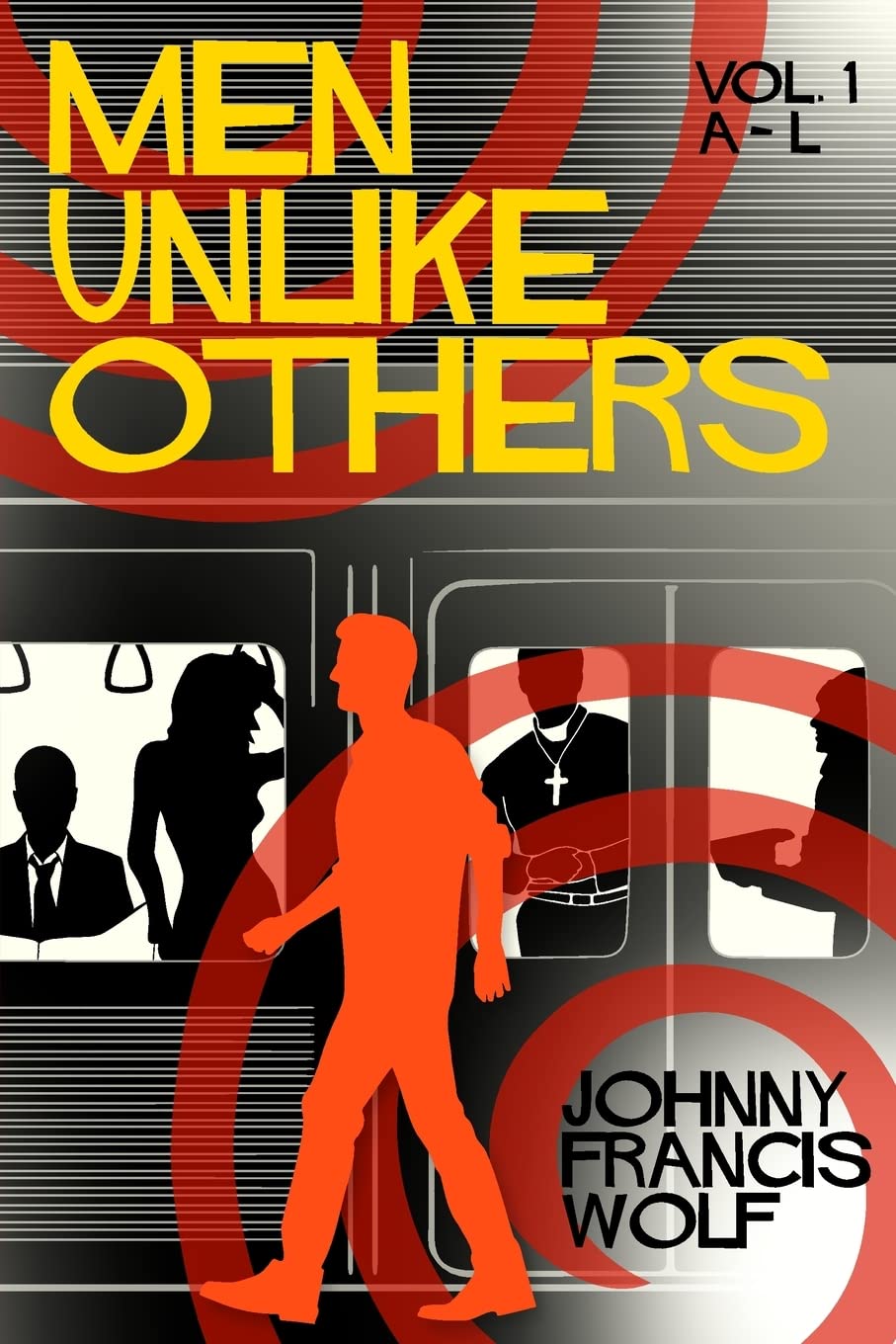
“No rhyme or reason as to who is next to whom. Worthy subjects, apart or together, for Norman Rockwell’s brush, Saul Bass’s graphic hand, or Johnny Francis Wolf’s quill.

A battered, old homeless man is given wide berth. Young gay couple share a giggle, scantily clad and on their way to a Pride event. Little boy in Mother’s lap staring, charmed by a face. Blind man pets the dog asleep between familiar legs.

Businessman, NY Times spread wide, is distracted by the shirtless lads laughing to his right. Ladyboy prostitute in daring dress and heels hangs dearly on a subway handgrip. Priest standing, facing door, eyes averted toward our hooker, wondering if the cleavage real, ignores the beggar reaching out a hand for help.

Way over to our left, a bearded man in red. Santa hat adorns his head.

No one is on their device.”

Johnny Francis Wolf describes himself as a Poet, Actor, Ranch Hand.. and a whole bunch else.

Below Johnny’s interview answers is the query letter I received from him when I first started Wild Ink Publishing. It didn’t fit the template of what publishers and agents shackle everyone to. And that is precisely why Wild Ink decided to publish him. Why start a new publishing company if you aren’t willing to take chances on nontraditional stylings? Why try to make waves in an industry if you don’t accept work that will make waves? Johnny does not disappoint!

You can purchase Men Unlike Others, Vol 1 here.


What inspired you to start writing?

Still trying to make it as an actor, I went the Billy Bob Thornton route. I attempted to write my own SLINGBLADE. Though, I do believe it was Sylvester Stallone who initially established this ‘pen your own first film’ with ROCKY.

Mine, called JELLY DONUTS, was a fun write..  took me three years.

Tiny back story, I was living in an under-code poolhouse in LA, with lots of exposed fiberglass lining the ceiling (more a garage with a tiny carve-out for pool supplies and one tenant). The fiberglass did little for warmth, but lots (of bad) to my lungs. And don’t let them fool you, fiberglass is as dangerous as asbestos.

The script, about a middle-aged Cerebral Palsy ‘kid’, occupied the healing years that followed — in the High Desert, north of LA. And it was during that more sedentary life, while getting back my breathing, that my homelessness began. My storied ‘massage’ career, my acting pursuits, my ability for side employment, all came to a hard stop during those years.

WRITING became HEALING. And I’ve plenty more of both in me, and needed. My lungs are better. My head, my demons, my past..  all mending. My search for a home, ongoing.

P.S. The script received little attention. But I haven’t given up on it.


What inspired you to write this book?

I had been amassing quite a library of stories and poems — written during and after the screenplay process — and thought they might have worth. A friend on Facebook just published her own and was doing quite well.

I endeavored to try the same. MEN UNLIKE OTHERS was born. The title purposely, tongue-in-cheek-ly ominous.


What is one thing you really want readers to know about your book?

It is me spitting out moments remembered, imagined, bent, and embellished. Some nice. Some bile. None bitter. No order (other than alphabetical).

Just when you think you have me pegged, I might hit you with a one-eighty.Of the two volumes — and by luck of the alphabetical draw — I think Vol. 2 is the meatier one. Though Vol. 1 is no slouch.

The two together are inseparable. One really needs both in their library.


Can you tell me a bit about your writing habit or the process you took in writing this book?

I write morning ‘til night, whenever I can squeeze in time. I seem to gravitate toward very early AND very late.

More, specific to the book, below.


What piece of advice would you give aspiring authors?

Please, please, please edit yourself carefully before showing the world. Misspellings and bad grammar lose eyes quickly. Awkward phrasing, even faster.

And lose my eyes, instantly.

Don’t ever think close enough is good enough.

It. Never. Is.

Ever.

MEN UNLIKE OTHERS took 18+ months just to cull, organize, proof, polish..  even AFTER it was already written, and BEFORE it was sent to prospective agents and publishers. Definitely polished well PRIOR to presenting it to Ian Tan for proper book editing.

Lastly. Get yourself a good laptop. IMHO, so much better for writing than an iPhone. I can’t even effin’ imagine. Set your damn bar higher.


What would you like to highlight about your writing career?

Below is my first reaching out, following my finish of the book… August, 2021.
I, initially, was looking for an Agent. (Ha!!)

You, Abigail, received my more Frankenstein Cover Letter, curated several times by the time I got around to you.. lots of fun cut-and-pastes. Too unwieldly for this exercise. But THIS Cover Letter might insinuate a little more about me. The ‘IF YOUR TIME IS SHORT’ preamble was, in fact, part of that letter.

The letter starts here:

––––––––––––

IF YOUR TIME IS SHORT

–  Unpublished Author looking for representation. 

–  I’ve recently completed a manuscript of 160 poems and short stories. 

 Men Unlike Others pontificates plenty on men.  Plenty, too, on the more frothy affairs I deem related.

–  I’d love to send you a sampling.

Below is a dizzyingly circuitous missive written to engage, amuse, beguile.  (Stop reading here if not easily engaged, amused, beguiled.)

––––––––––––

August 1, 2021

Submission Query

–––––

Dear Mr. Literary Agent (name changed),

A part of me will ever be this way. 

I look for pretty pictures.  Handsome faces.  Men.

–––––

An unrelated  ––  maybe  ––  googling of poetry publishers yielded too many blazoners of books…  too beaucoup a band of bard boosters and backers to imagine tendering that many cover letters.

Muckraking cross the top ten aggregate sites (who each offered a collated top fifty), purging the duplicates, I weeded out well more than half those left as self–publishing (with me not interested). 

Eliminating the survivors requiring contest submissions (often with entry fees), culling through printers who have long since abandoned poesy as a promotable literary genre, curating the few remaining classic compositors accepting unsolicited words, turns out exactly one is yet open to verse proffers  ––  bidding welcome Christian odes only.  Of course, I embroider some of the particulars.

But left me thinking, “A better life through representation.”

Engaging someone who knows how best to find and forge a publisher/author relationship just sounds smart.  Having dabbled in acting over the years, I recall how ably a talent agent aided my seeking auditions and thespian employment. 

Perhaps the same would work here.

–––––

Returning to my initial tease apropos of men and handsome faces, I began a new and pioneering online search.  This time for literary agent.  I ordained that pictures helped  ––  furthered my examen  ––  and divined good–looking male headshots seemed draw.

Yours, Mr. Literary Agent, stood top of that list. 

Googling you, your works, your wedding earlier this Century, made for a well–rounded and deep dive into the sort you are, attendant the type of person who might be interested in representing an idiosyncratic poet (check), who is similarly gay (check), and not 19 (check, check). 

Anything further and personal beyond those three is irrelevant.  So stated to assuage any fears about my predilection to a nice visage.  Specifically yours..

Simply trying to address the probing in your Agency’s submission guidelines as to, “how you heard about TCA.”

–––––

I am a homeless gypsy  ––  an artist, actor, unpublished writer  ––  making little money and currently living in my brother’s attic.

I am autistic and savant.

Acting classes helped enormously deciphering how to bide in genteel society…  imparting methods that accorded me the means to ‘fake it’ when my own cerebral editor could not feel for best practices. 

Withal, I am still very much a loner.  And, as this introductory email reveals, can be quite prone to gaffes..  verbal as well as writ…  precipitously impromptu else laggardly circumspect.

A dangerous hallmark to lay claim to (and clear proof of) when hastening headlong unto a description of one’s manuscript  ––

–––––

My book is comprised of 160 poems and short stories.

Men Unlike Others is not devoted expressly to males but to all the subjects this gay man enjoys expounding upon  ––  men, beasts, writing, men, life, family, aging, men, angels, gods and men.   Did I mention men? 

And any the shades of gray and light betwixt.

Whilst marbled and layered and oozing deep thoughts (SNL’s Jack Handey would approve), I aver my tales are firstly entertaining…   deceptively lean and airy.

With gaffes edited out, except when felicitous.

I’d love to share more.  I beg you consider asking me this very thing.

Yours faithfully,

Johnny Francis Wolf

–––––

P.S.   A dear friend once described my wordplay in a way I thought both crudely apt and much too kind.  I paraphrase  ––

Three grains of sand and fuck the rest.. 

         plumb as they ford, if solely but then… 

                     the narrowest cut of an hourglass stem.

–––––

P.S.S.   Whilst unpublished in a very real sense, a few of my earliest poetic swings (and misses) can still be found on social media. 

Some wide–eyed and cringeworthy verses, I fear. 

(I’ve nothing against ‘wide-eyed’ as a style.  I wield it often.  I find fault when it belies a slapdash effort.  And a goodly bestirred ‘cringe’ can be lovely.  When deliberate.)

There even exists a handful of primordial odes commandeered by sweet and self–published friends for their anthologies / blogs. 

Ignoble attempts mine, these originations. 

If 2 years of self–editing has taught me anything, it is to never hence present works–in–progress for public consumption. 

No wine before its time.

Best save them for a thirsty compositor.

An Interview with S.E. Reed

An Interview with S.E. Reed

Author Interview with S.E. Reed, Author of “My Heart Is Hurting”

Q: Bookmark your page or dog ear it?

A: Dog ear. I move my books around the house with me too much, bookmarks tend to fall out.

Q: Re-read books or read a book once and move on?

A: Looooove the re-reads! I’ll go back just to read memorable scenes in my favorite books.

Q: Do you prefer reading books from debut authors or more seasoned authors?

A: I buy a mixture of both. The problem with debut authors… I fall in love with them and have to wait FOREVER for their next book to come out.

Q: Adult or YA?

A: Mostly YA… but I do love the Outlander series!

Q: Do you prefer single POV or dual POV novels?

A: Honestly, I couldn’t tell you the last time I read a dual POV. BUT… I write a lot of dual POV. Soooo, there’s that!

Q: Do you want each book to stand on its own, or are you trying to build a body of work with connections between each book?

A: I write in various genres. My Heart is Hurting is contemporary YA set in South Florida. My 2nd novel releasing with Wild Ink Publishing is also a contemporary YA set in South Florida. The two stories aren’t connected, but they have some of the same vibes. I write a lot of short stories in the same area with similar themes. BUT– shift gears to my sci-fi/fantasy… I have a trilogy coming out that is a dystopian retelling of Beauty and the Beast. Which means, not in Florida. So, I have range. 🙂

Q: How did publishing your first book change your process of writing?

A: I totally pantsed My Heart is Hurting. Since then, I’ve started drafting outlines and keeping more detailed chapter notes as I go along. Having worked with an editor, I’m more well equipped now to know what to look for and how to track my own progress.

Q: How many hours a day do you write?

A: I spend about 2 hours each weekday and 4-5 hours a day on the weekends. More if I can squeeze it in. Writing is addicting.

Q: How long on average does it take you to write a book?

A: On average about 6-8 weeks. It’s the revising, editing, querying, revise & resubmits that take all the time. I prefer just to write. The other stuff is my frenemy. 😉

Q: What advice would you give to a writer working on their first book?

A: Stick to the standards within the genre you are writing. They are there for a reason.

Q: How do you select the names of your characters?

A: It’s weird to think about naming people. But, they just pop into my head. I honestly don’t have to think about it much, the character forms and the name is just part of them. I named my kids that way, like, I just knew their names early in my pregnancies. Maybe they are the ones who told me– I try to listen to my peeps.

Q: How many unpublished and half-finished books do you have?

A: Oh god, do you really want to know? Let me count… brb…

Okay, so I have 2 contemporary YA’s signed for upcoming publication. I have 3 sci-fi YA signed for upcoming publication. 1 NF signed for publication.

That leaves 5 completed YA fantasy manuscripts without homes. And I have 4 in-progress YA manuscripts of various genres. Oh, 1 completed unsigned sci-fi novella. AND about 50 short stories.

(Did I mention I’m addicted to writing?)

p.s. sorry to any books of mine I’ve forgotten… I still got love for you bro.

Q: Have you ever named a child or a pet after a character you love?

A: No, but I named the lead characters in my YA Fantasy series after my children.

Q: How old were you when you fell in love with reading?

A: In elementary school I used to hide in my closet and read for hours. Soooo… that was probably the start of it. I’m not ashamed to say, I’ve stood in line at midnight to buy a book the second it was released.

Q: Is there a genre you have never read?

A: I’m not a blood/guts/horror movie fan, so I don’t intentionally read graphic horror novels. I like thrillers and creepy/spooky, just not icky bloody freak show stuff.

Q: What type of book do you prefer? Ebook, Paperback, Hardback, Audiobook

A: I like paperback or hardback. I write so much on a computer, I don’t care to read leisurely on a screen. And I’ve never listened to an audiobook! I know, I’m horrible.

Purchase My Heart is Hurting by S.E. Reed here.